
golf cart battery modification
48V 105Ah Lithium Golf Cart Battery Upgrade: Longer Range, Less Maintenance, More Confidence
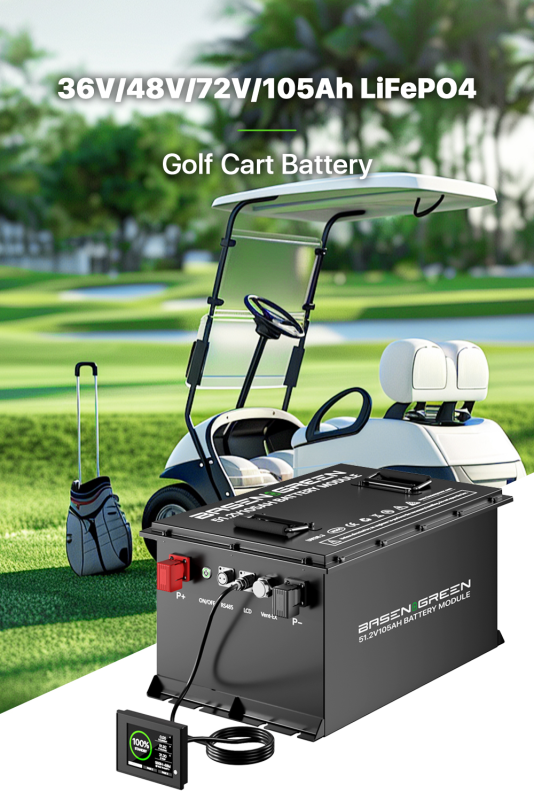
If you’re still running a traditional lead-acid pack, you already know the routine: performance fades as the round goes on, charging takes forever, and “maintenance day” becomes a recurring event. A modern LiFePO4 (lithium iron phosphate) battery changes the experience—lighter, more consistent power, and far less upkeep.
This guide breaks down what a 48V 105Ah lithium golf cart battery upgrade actually delivers in the real world, using the Basengreen USA STOCK · 48V 105Ah Lithium Golf Cart Battery (Includes Charger) as the reference build.
Quick Takeaways (Read This First)
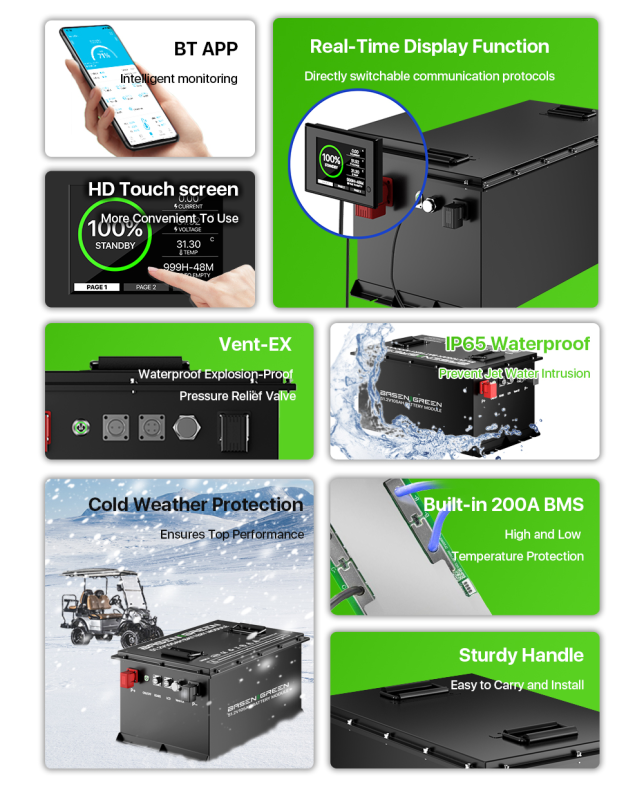
- Range: Designed to deliver up to ~50 miles per charge depending on terrain, load, speed, and driving habits.
- Power & protection: Built-in 200A BMS helps protect against overcharge, over-discharge, short-circuit, and temperature extremes.
- Visibility: Mobile app monitoring lets you check SOC (state of charge), voltage, temperature, and more in real time.
- Weather-ready shell: IP65 dust/water protection for everyday outdoor use.
- Form factor: Size 510 × 325 × 265 mm, weight 49 kg—compact enough for many common 48V cart battery bays.
Why Lithium Feels So Different Than Lead-Acid
A lead-acid cart can feel strong at the start, then sluggish later—especially on hills or when carrying passengers. That’s because lead-acid voltage tends to sag more under load, and usable capacity often depends heavily on how deeply you discharge and how hard you draw current.
LiFePO4 behaves differently: the discharge curve is flatter, so acceleration and hill-climb feel more consistent across the ride. Combine that with “no watering / no acid cleanup / no corrosion maintenance,” and lithium quickly becomes less about “spec sheets” and more about fewer headaches.
Meet the Basengreen 48V 105Ah Pack (The “105Ah Sweet Spot”)
A 105Ah lithium pack is a practical middle ground: enough capacity to comfortably handle typical rounds, neighborhood driving, and light utility use—without jumping to a larger/heavier/higher-cost pack unless you truly need it.
Basengreen USA STOCK · 48V 105Ah Lithium Golf Cart Battery (Includes Charger) highlights:
- Up to ~50 miles per charge (usage-dependent)
- 200A BMS protection
- App monitoring (SOC + key telemetry)
- IP65 rugged rating
- Size 510 × 325 × 265 mm; Weight 49 kg
How much energy is 48V 105Ah?
As a quick rule of thumb, “48V-class” lithium golf cart packs are roughly ~5 kWh (order of magnitude), which is why they can cover multiple rounds or long neighborhood trips when the cart is in good mechanical condition.
Real-World Benefits on the Course (and Off It)
1) More usable range (not just “rated Ah”)
On paper, lead-acid Ah and lithium Ah look similar—but in practice lithium tends to give you more usable energy without the same “end-of-round fade.” That’s why owners often describe lithium as feeling like a cart upgrade, not just a battery swap.
2) Stronger, steadier hill performance
If your course has elevation changes, lithium’s stability under load is one of the first things you notice. With a 200A BMS, the goal is steady output while protecting the cells during demanding draws.
3) Less downtime, simpler ownership
No watering. No acid. No corroded terminals from venting. Less time troubleshooting “why it feels weak today.”
4) Battery visibility with an app (goodbye guessing)
Knowing your SOC (and seeing key readings like voltage/temperature) helps you plan charging and catch issues early—especially helpful for fleet operators or families sharing the cart.
What the BMS Actually Does (And Why You Should Care)
A lithium pack isn’t just cells in a box. The BMS (battery management system) is the traffic controller.
A typical lithium golf cart BMS is designed to help reduce risk from:
- Over-charge events
- Over-discharge events
- Short-circuit faults
- Temperature-related extremes
In daily use, this matters because it helps reduce “one bad day” events—like accidental deep discharge, wiring mistakes during installs, or harsh operating conditions.
Ruggedness & Weather: Why IP65 Matters
Golf carts live outdoors: early-morning dew, surprise rain, dusty paths, washdowns. An IP65 enclosure is built for that reality—helping keep dust out and resisting water ingress from typical exposure.
Quick note: IP ratings don’t mean “invincible.” Always mount securely, keep cables tidy, and avoid direct high-pressure water jets at seals and connectors.
Installation Notes: How to Set Yourself Up for Success
Every cart is a little different, but these steps prevent most install mistakes:
- Confirm your system voltage is 48V
Don’t guess—check the cart manual or existing battery configuration. - Measure your battery bay
Compare against the pack size: 510 × 325 × 265 mm. - Inspect cables and main connections
Old corroded cables can bottleneck performance even with a new battery. - Secure the pack properly
Use a robust bracket/strap method to prevent vibration damage. - Do a low-speed shakedown test
First ride: flat ground, light load, verify smooth acceleration and normal temperature.
If you run accessories (lights, USB, sound system), confirm you’re powering them safely and appropriately (many setups require a proper converter depending on accessory voltage).
Charging: What to Expect (And How to Keep It Simple)
Because this version includes a charger, compatibility is simpler for most buyers.
Best practices:
- Charge after use if you can—lithium doesn’t need “full discharge cycles.”
- Avoid leaving the pack at 0% SOC for long periods.
- If storing for weeks, store at a moderate SOC and in a reasonable temperature environment.
Who Should Choose 105Ah (And Who Should Go Bigger)
105Ah is ideal if you:
- Play regular rounds and want confident range without extra weight/expense
- Drive mainly on course paths, neighborhoods, or light utility routes
- Want a balanced “value vs. capability” lithium upgrade
Consider a larger pack if you:
- Frequently carry heavy loads or multiple passengers for long stretches
- Run steep hills daily
- Need extended runtime for fleet duty cycles
Frequently Asked Questions
How far will a 48V 105Ah lithium golf cart battery go?
Many 105Ah lithium golf cart builds are marketed for up to ~50 miles per charge, but real range depends on terrain, cart condition, tire pressure, payload, and speed habits.
Does it have safety protection?
Yes—quality lithium packs use a BMS to help protect against overcharge, over-discharge, short-circuit, and temperature extremes.
Can I monitor the battery on my phone?
If your battery includes app support, you can typically monitor SOC and key telemetry in real time.
Is it weather-resistant?
An IP-rated enclosure (such as IP65) helps with dust and normal water exposure, which is ideal for outdoor carts.
What are the size and weight?
Reference size: 510 × 325 × 265 mm; reference weight: 49 kg.
Bottom Line: A Practical Lithium Upgrade That Feels Like a Cart Upgrade
A 48V 105Ah LiFePO4 pack is one of the most noticeable “quality-of-life” improvements you can make to a golf cart. More consistent power, less maintenance, better visibility into SOC—and the freedom to stop planning your day around battery quirks.
If you want a balanced solution that covers most real-world golf and neighborhood driving needs, a 48V 105Ah lithium battery kit with a matched charger is built specifically for that job—range, protection, monitoring, and a rugged outdoor-ready enclosure included.
